

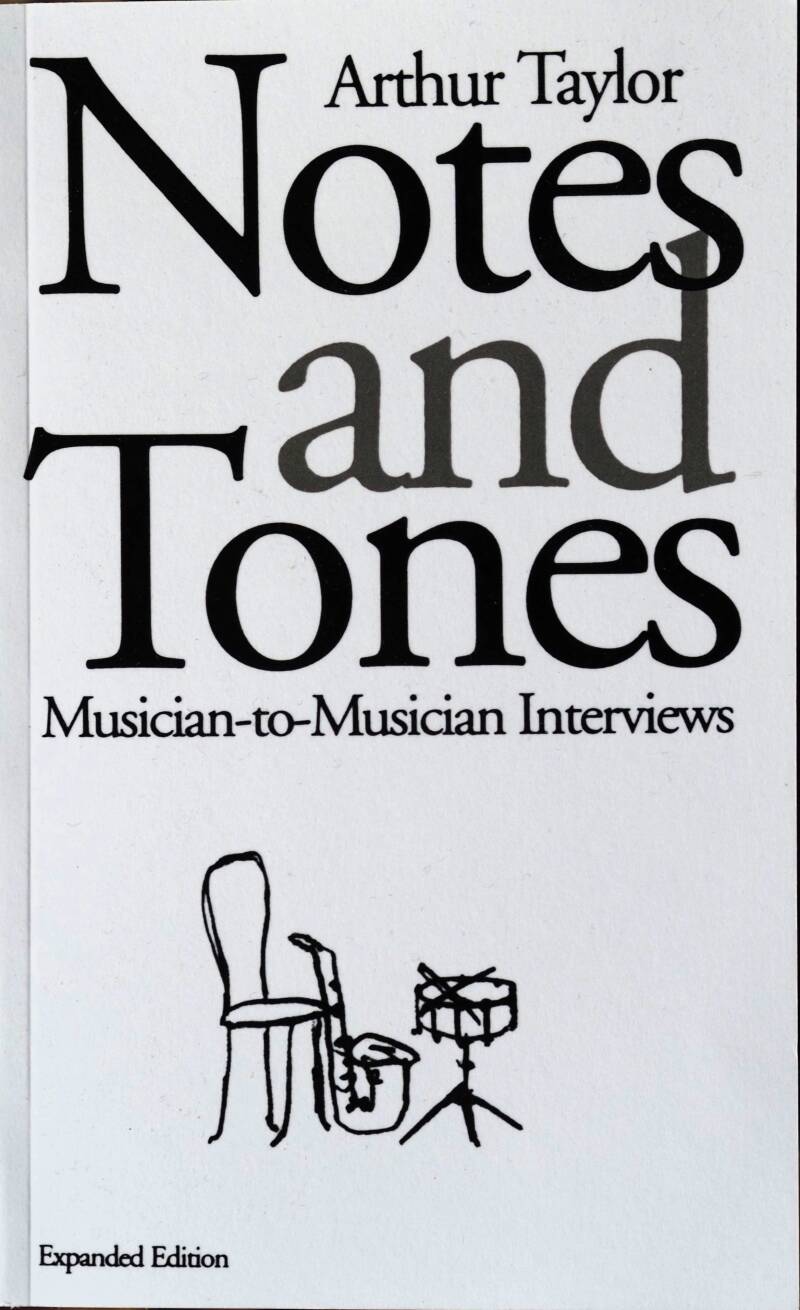
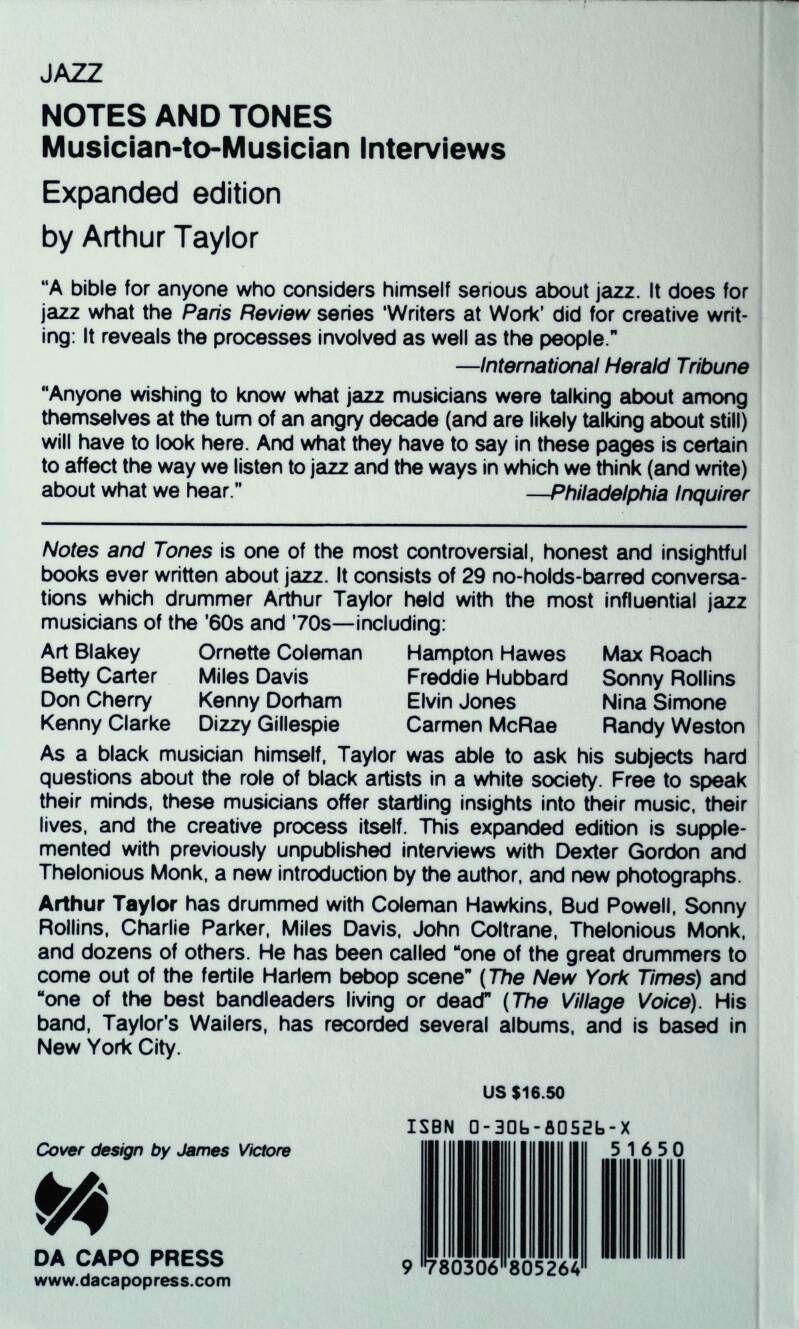
Art Taylor – Notes and Tones: Musician-to-Musician Interviews (Expanded edition)
DaCapo Press
ISBN 0-306-80526-X
Habe ich letztens eher zufällig erfahren: Arthur „Art“ Taylor, der Mann der 323 dokumentierten Plattenaufnahmen, war mit seiner musikalischen Karriere keinesfalls ausgelastet, sondern auch als Autor aktiv: Zwischen 1967 und 1972 interviewte er führende schwarze Musikerinnen und Musiker. Er veröffentlichte die gesammelten Gespräche in einem denkwürdigen Buch.
Ich habe einige Bücher über Musik, und besonders Jazz, aber Taylors Notes and Tones: Musician-to-Musician Interviews, das erstmals in den 1970er-Jahren erschien, ist anders: Es ist nämlich kein Sekundärwerk, in dem ein (meist) weißer Kritiker aus der Vogelperspektive über schwarze Musik schreibt, sondern hat den Geschmack eines ehrlichen und ungeschönten Dialogs auf Augenhöhe. Ein Gespräch unter Kollegen in einer Atmosphäre gegenseitigen Vertrauens und Respekts, unzensiert und ohne Schranken.
Die Interviews wirken wie der Jazz selbst – oft scheint ein Rahmen vorgegeben, aber es wird viel improvisiert und man folgt der natürlichen Dynamik des Gesprächs anstatt einen vorgestanzten Katalog abzuhaken. Taylor stellt dabei Fragen, die weiße Kritiker nicht stellten, vielleicht auch nicht stellen konnten. Häufig, aber nicht nur, geht es um Rassismus in der Musikindustrie, finanzielle Ausbeutung, das Leben als schwarzer Künstler in einer weißen Gesellschaft und den Begriff „Jazz“ an sich. Das liest sich manchmalt ziemlich bedrückend, aber zum Glück bietet das Buch auch genügend leichtere Momente; zwischendurch geht es nämlich oft um Musik, natürlich, aber auch um Trainingsprogramme und Fitness, und es gibt philosophische Betrachtungen zu Kunst, Spiritualität und Gesellschaft.
Taylor lässt die Gespräche weitgehend in ihrer natürlichen Umgangssprache stehen. Das liest sich nicht wie klassischer Journalismus, sondern wie ein direkter Mitschnitt aus der Garderobe oder dem Backstage-Bereich. Als Leser erlebt man eine echte Perspektivenrotation, sieht die Dinge ungeschönt aus der Sicht derjenigen, die man sonst nur von ihrer Musik auf Blue Note, Riverside, Prestige et al. kennt. Wir lernen, wer diese Leute waren, unter welchen Bedingungen sie gearbeitet haben und wie sie ihre eigene Musik verstanden.
Das Buch trägt ein starkes Zeitkolorit. Die Interviews spiegeln die drängende, gereizte Stimmung der späten 1960er und frühen 1970er Jahre wider. Bürgerrechtsbewegung, Black Power und die Stellung schwarzer Künstler in der amerikanischen Gesellschaft sind allgegenwärtig. Das macht Notes and Tones zu einer wichtigen historischen Primärquelle. Das Buch ist politisch, aber niemals im Sinne eines trockenen Traktats, vielmehr ist es lebendige Zeitgeschichte.
Art Taylor veröffentlichte Notes and Tones ursprünglich 1977 im Selbstverlag. Meine Ausgabe von DaCapo erschien 1993 und ist um zwei Interviews erweitert – mit Dexter Gordon und Thelonious Monk, und ein Interview mit Monk darf man sich auf gar keinen Fall entgehen lassen! Das Buch wurde bis heute nicht ins Deutsche übersetzt, Interessenten sind weiterhin auf die englischsprachige Originalausgabe angewiesen.
Um euch einen Eindruck von Ton und Sprache zu geben, findet ihr unten eine Auswahl von Fragen und (notwendigerweise gekürzten) Zitaten, die Notes and Tones letztlich viel besser erklären als jede Rezension. Art Taylors Fragen sind kursiv gesetzt.
Johnny Griffin
… I’m not really from this planet. I did something wrong on my planet and they sent me here to pay my dues. I figure pretty soon my dues should be paid, and they’re going to call me back home so I can rest in peace.
You’re not serious about that, are you?
I can’t be from this place, Arthur. There is no love here, and I love people…
What was it like working with Art Blakey?
Fantastic! It was like sitting on an atomic bomb. That was a fantastic experience because Bu ist so strong with his thing…
Ron Carter
What about your fingers? Do you do any special exercises?
I’m really opposed to specific exercises. You see piano players who sit up and tap their fingertips individually on tabletops all day. You see bass players who take a rubber ball or a hand grip. It may give you strength, but it does not give you control; I may not have the strongest physical hand, but I have the ultimate control of all my fingers independent of each other. For me the key word is finger control rather than strength.
Max Roach
Where did the term be-bop come from?
"Be-bop“ is the name of a song written by Dizzy Gillespie. As far as I can remember, critics called the music be-bop when they came into the club where we were playing at that particular time, on Fifty-second Street. The music was so unique and unusual, so fresh and original; they asked Dizzy what he called it, and perhaps Dizzy misunderstood their question, or maybe he told them the title of the tune… we were playing a song called "Be-bop“ and they called the music be-bop.
Do you think boxing is comparable to music?
I think it is a definitive skill and that it’s been raised to the level of an art form by black fighters. It’s not just beating somebody but is as highly developed as fencing or tennis. Rhythm has something to do with timing.
Do you think the music business is controlled, in the sense that someone can take a particular artist and turn him or her into a great artist?
Not in that sense. I think time will tell which person is a great artist.
Dizzy Gillespie
Tell me, Birks, how do you like Stockholm?
There’s a nice feeling up there. The political system is pretty good, too. For people who are looking for materialsitic advancement, it’s no good; but for people who are interested in the betterment of the whole society, it’s great. Suppose you get married and have ten children; their education is guaranteed all the way through. If you get sick you can get hospitalization. If you’re out of work you’ve got a place to stay, something to eat and clothes to wear. I think it’s just marvelous….
Miles Davis
Do you have a list of things you want to ask me?
No, I would like to ad-lib.
Hello, hello, hello my ding. Look out, look out, my duke. What do you want to talk about, Arthur?
Why do you go to the gymnasium so often, Miles?
I go to the gym to keep my body in shape, so I can hold notes longer, so my stomach will be flat and so I’ll look handsome.
How do you go about picking a drummer for your band?
First I look at my ding! When I look at a drummer it’s just like when I look at a fighter. I watch his reactions to different things, his quickness, whether he’s on time and whether he can clean up, you know what I mean?
Randy Weston
Would you like to make your home in Africa?
Oh, yes! I think that by settling in Africa I’ll have an opportunity to learn more about myself, my family and my ancestors. I also think that I‘ll learn a little more about the music I play, which is called jazz.
Do you believe our music originally came from Africa?
There’s no doubt about it. I’ve listened to African music and I’ve heard everything from old-time blues to avant-garde. Africa is the creative source.
Nina Simone
How did you become interested in music, Nina?
It wasn’t a matter of becoming interested in music; music is a gift and a burden I’ve had since I can remember who I was. I was born into music. The decision was how to make the best use of it.
Are you religious?
Oh, yes, but I have no particular religion.
Can you find God in your music?
Of course, all the time.
Can you explain that?
How do you explain what it feels like to get on the stage and make poetry that you know sinks into the hearts and souls of people who are unable to express it?… That’s God.
Have you ever been categorized as a jazz singer?
They can’t seem to decide. Some critics say I’m a jazz singer, others say I’m not. Still others say I’m a jazz singer plus another kind of singer. The truth is they don’t know what I am, and I’m glad.
Thelonious Monk
When are you going to start a Thelonious Monk record company or booking agency?
When I get enough capital. I don’t want to own everything. Let everybody make some money.
When you started out at Minton’s, did you realize the effect your music would have in later years?
I always figured that any music which sounds good would have effect. It’s just like us having effect on each other because we meet and play together.
Fazit: Notes and Tones bietet Einblicke in das Leben und Denken von Jazzmusikern, wie man sie bei Down Beat oder Jazz Thing nicht bekommt. Eine Pflichtlektüre für alle, die sich nicht nur für Jazz interessieren, sondern auch für die Menschen, die ihn spielten.
Kommentar hinzufügen
Kommentare